Imagine a digital canvas where ideas are not merely typed but orchestrated; a place where working with generative intelligence becomes as nuanced and expressive as composing a symphony. A digital workstation, reminiscent of cutting-edge music production software, becomes the interface for a new kind of artistry — layered tracks of text, voice and biometric prompts, inputs interwoven, each segment carrying a different nuance or emotion, allowing the meticulous sculpting of multimedia output: human expression. We call this canvas the Interactive Perspective Sphere (IPS) — and, as the rest of the Labs research record argues, it is driven first by speech: Speech‑to‑Action carries the controls, Speech‑to‑Orchestration carries the coordination, and the interface elements below are the surfaces those spoken acts will grow into.
Maya E. Davis · Duránd F. Davis Jr. · Labsintelligence Cite as: Davis, Maya E., and Duránd F. Davis Jr. “Interactive Perspective Spheres.” LabsAI Research Notes, Labsintelligence.
The thesis. An Interactive Perspective Sphere enables a future — from Web3 into Web4’s spatial web — where productivity, art and technology resonate with the personal touch of each creator, crafting experiences and realities with the complexity and richness of human imagination itself. As we venture into that world, we embrace the promise of AI not as a replacement for human creativity but as a collaboration catalyst that amplifies the beauty and depth of what we can conceive and create.
01The Interconnected Generative Era
The sphere is a gateway into what this note names the Interconnected Generative Era — the entrance into Web3 and the bridge to Web4 and beyond: a digital era in which advancements in text, image, video, spatial, biometric and, in time, quantum computing are not merely accessible but integrated as one, so that people harness diverse generative technologies effortlessly, together, and in their own voice.
Our thesis is that Interactive Perspective Spheres become the unified platforms of that era. Delving into the possibilities of such a tooled interface can redefine business, productivity and creative processes, enhance the partnered dance between human and AI, and unlock a spectrum of omnological possibilities — especially alongside advanced computing such as quantum, nano and DNA — that today lie dormant behind technological restriction. Labs’ own debuts pointed the way: Yuhmmy, the world’s first Social‑Taste Super App™, and LaLaMo — introduced in this note’s first era as the Labs large language model, and standing today as Labs Large Models, the large archetype within LAIMA. We envision humans experiencing these technologies, and the interconnected generative ones around them, through Interactive Perspective Spheres.
02Four broad capabilities
The sphere’s broad capabilities reshape our interaction with technology by integrating human ingenuity with machine intelligence. Four examples define the ambition — and note how each is, at heart, an orchestration competence before it is an interface:
DCADynamic Contextual Adaptation
The sphere intelligently adapts to the creator’s current project context — crafting a narrative, composing music, designing a business strategy. By analyzing the content and intent behind each prompt, the system dynamically adjusts its suggestions, tools and settings to the task at hand: an AI partner that not only understands the specifics of your project but brings forward the most relevant resources and inspirations to amplify the creative process.
CFDCreative Flow Detector
Leveraging biometric signals, the sphere detects when the creator is in a state of optimal creativity — flow — and adjusts itself to sustain it: minimizing distraction, optimizing suggestions, tailoring the creative environment. That could mean altering the ambient character of the interface, modifying the complexity of prompts, or streamlining the workflow so the creator stays fully immersed.
GEPGenerative Evolution Paths
Creators set initial parameters and watch the sphere generate multiple evolution paths a project could take, visualizing potential directions and end states before committing to one. GEP is a sandbox for imagination — particularly powerful for long-horizon projects and complex narratives — where every “what if” is visualized and considered.
GCMGlobal Collaborative Matrix
Beyond real-time collaboration: a seamless, immersive environment for collective creativity, supporting synchronous and asynchronous creation in a shared space that mimics physical presence — instant feedback, live brainstorming, joint creation across the world, with translation intelligence dissolving language barriers into a truly global platform.
03The instrument panel
Within those capabilities, features draw inspiration from advanced software interfaces and the intuitive tactility of real-world instruments. Two things should be read together here. First, the roster — envisioned as the sphere’s controls. Second, the delivery order the Labs stack has since made concrete: each of these arrives as a spoken act first — a sentence to the intelligence, resolved through Speech‑to‑Action — and becomes a visible instrument only where seeing it adds something. The panel is a reflection of the conversation, never a wall of controls.
Semantic Depth Sliders
Adjust the interpretive depth of prompts — one end literal and precise, the other inviting creative liberty and abstraction.
Emotion Tone Pads
Pads in the manner of a MIDI controller, each assigned an emotional undercurrent — joyful, sombre, ironic, mysterious — infusing prompts with feeling and guiding the creative direction.
Emotion Palette
A personal library of previously captured and interpreted moods, applied or adjusted without rescanning — emotionally consistent characters and thematic series at a touch.
Context Dials
Rotate the frame of reference — historical periods, cultural contexts, artistic movements — anchoring prompts within a chosen world.
Sensory Detail Enhancer
Amplify the senses of a scene: sliders for sight, sound, smell, touch and taste, sharpening vividness where the story needs it.
Temporal Shift Controls
Manipulate the flow of time in a narrative — accelerate, slow, flash back, foreshadow, blend eras — stories as layered as memory itself.
Narrative Progression Trackpad
Draw or swipe along a timeline to evolve narrative or visual elements across a single prompt sequence.
Interactive World-Building Map
Construct and navigate whole settings through a living map — regions, climates, cultures — for the game developers, writers and filmmakers who need coherent worlds.
Gesture Control Integration
Hand movement as conductor’s baton — a fluid physical channel alongside text, voice and expression.
AI Suggestion Window IN THE STUDIO
A dedicated space where the intelligence offers alternatives, feedback and even conceptual overhauls — a creative assistant thinking alongside you.
Real-time Visual Previews IN THE STUDIO
A central workspace previewing output live as prompts adjust — immediate feedback, quick iteration.
Macro–Micro Focus Toggle
Shift between the whole (theme, style, mood) and the detail (texture, element, finish) without losing the bigger picture.
Inspiration Feed
A live, curated stream of trending motifs, styles and palettes to tap for inspiration.
Collaboration Switchboard
Share control of prompt layers, lock elements, hand off the creative lead — a live set where control passes cleanly between creators.
Modular Plug-in Slots
Specialized modules for scriptwriting, game design, architectural visualization — the sphere extends to the craft at hand.
AI-Powered Genre Blender
Merge characteristics across genres into new hybrids, with the intelligence proposing prompts, themes and structures for the genre you just invented.
04Anatomy of a sphere
Technically, a perspective sphere is a composition function over layered input tracks. Where a chat interface consumes one string, a sphere consumes a set of time-aligned lanes — typed text, live speech, affect read from voice and camera, application state, and the register the creator has dialed in — and composes them into each generation call. The tracks are not interchangeable: speech carries intent and timing, the biometric lane carries how the creator feels about what is emerging, application state carries what already exists on the stage, and the register carries standing creative direction that outlives any single utterance.
Figure 1The track stack
05The register machine
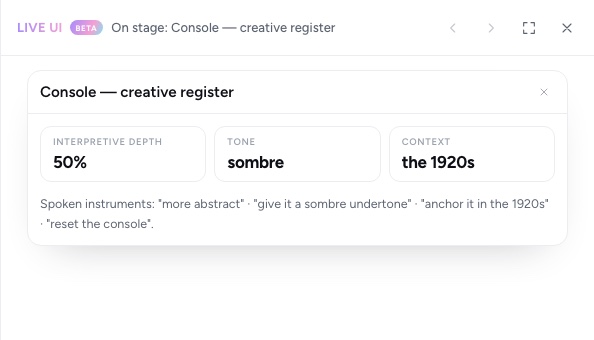
The sphere’s instruments reduce to a small piece of state — the creative register — and a set of spoken transitions over it. In the first-generation implementation the register is a triple: interpretive depth (0–100, literal to abstract), tone (an emotional undercurrent, or none), and context (a frame of reference, or none). Each spoken act is parsed against transition rules — cumulative, so one sentence may turn several dials — and every generation that follows is modulated by the current register until it is changed or reset. The register is orchestration state, not model state: it lives in the layer that composes the call, which is what makes it instant, inspectable and reversible.
Figure 2Spoken transition → state → generation
Artifact ARecorded session · app.labsai.studio
The first spoken instruments, live. One typed-or-spoken sentence — “give it a sombre undertone and anchor it in the 1920s” — set two dials at once; “open the console” staged this reflection card in the Live UI panel. Captured from a recorded session on the production Studio.
06Evolution paths, formally
A Generative Evolution Path treats the project as a tree, not a line. The current state is a node; “show me three directions” forks it into labeled branches — each a genuinely different treatment generated under the same register — staged side by side for inspection. Picking a branch commits it: the chosen path becomes the new trunk, the others are dismissed, and development continues from there. The spoken pick rides ordinary reference resolution (“the second one”, a name), which is what keeps branching conversational rather than administrative. Version history within a branch remains linear undo; GEP is the lateral move it never had.
Figure 3Fork, inspect, commit
07The collaborative matrix, technically
The Global Collaborative Matrix is the sphere’s hardest engineering claim, and it decomposes into four problems with known shapes: shared session state (multiple creators bound to one stage, with conflict-free merging of concurrent edits to artifacts and register); presence (who is looking at what, who holds the floor, the hand-off of creative lead); the translation layer (speech-to-speech across languages inside the loop, so collaboration is genuinely global); and attribution (which track of the layered input came from whom — the multi-creator version of the provenance discipline the Labs stack already enforces on data). Each is registry-tense road ahead; none requires physics the current stack lacks, and the single-creator sphere running today is deliberately built so that a second creator is an addition, not a rewrite.
08How a sphere is driven
When this note was first written, the instruments above read as an interface. The years since sharpened the claim: a perspective sphere is driven by speech before it is touched. “Make it more abstract” is the semantic depth slider. “Give it a sombre undertone” is the tone pad. “Anchor this in the 1920s” is the context dial. “Show me three directions this could go” is a Generative Evolution Path. Speech‑to‑Action (STA) resolves the spoken act against what is on the stage — each such act a Speech‑to‑Action Voice Command, the unit of spoken work the platform runs, with its coordination twin the Speech‑to‑Orchestration Voice Command; Speech‑to‑Orchestration (STO) decides which intelligence does the work and keeps the floor alive while it happens. The instruments then appear as reflections — visible state you can also touch — rather than as walls of controls to learn.
That is the order of arrival the LabsAI Studio already demonstrates: a generative stage built while the voice speaks, spoken commands resolved against live on-screen objects, previews and suggestions as standing features, and the first spoken instruments of the sphere — depth, tone, context, evolution paths — landing as conversation. The remaining capabilities — the flow detector, the collaborative matrix, the world map, gesture — are named plainly as road ahead, in research and development, in the same registry tense the Labs record uses everywhere.
What the sphere’s first working surface became is recorded in the companion notes.
Written by Maya E. Davis; carried into the Labs research canon with Duránd F. Davis Jr.
Tell us what you think, join us
This research is published while the questions are still open, and the systems it describes are live. We would love for you to join us — and please share your thoughts at research@labsintelligence.ai.
Citation
Please cite this work as:
Davis, Maya E., and Davis, Duránd F., Jr., “Interactive Perspective Spheres.” LabsAI Research Notes, Labsintelligence — lab1 of Labs Companies, Inc., August 2026.
Or use the BibTeX citation:
@article{labsintelligence2026interactiveperspectivesphere,
  author  = {Davis, Maya E. and Davis, Duránd F., Jr.},
  title   = {Interactive Perspective Spheres},
  journal = {LabsAI Research Notes},
  publisher = {Labsintelligence, lab1 of Labs Companies, Inc.},
  year    = {2026},
  month   = {august},
  url     = {https://labsintelligence.ai/research/labsai/interactive-perspective-spheres/},
}